
Data centres’ growing environmental and social impacts require urgent, coordinated action through stronger sustainability policies and rapid adoption of industry best practices tailored to their high energy use, large scale, and effects on local communities.
As data centres rapidly expand to support digital infrastructure, the planning and permitting stage is the most critical intervention point. Decisions here will lock in decades of impacts on local energy systems, water resources, and community development.
The key question is no longer simply how efficient a data centre is, but what it means for the place in which it is built.
For planners, policymakers and communities, the priority must be a shift toward understanding absolute and system-level impacts. This means asking fundamental questions about:




In this context, commonly cited metrics like Power Usage Effectiveness (PUE) and Water Usage Effectiveness (WUE) have a role, but a limited one. These metrics describe operational efficiency, not overall impact. A data centre with an excellent PUE can still place massive strain on a local grid simply due to its scale. Similarly, a ‘low’ WUE may still represent significant water use in a water-scarce region.
This creates a real risk: when used in isolation, relative metrics can obscure more than they reveal. They can shift attention toward marginal efficiency gains while masking the more material issue: rapidly growing total demand. In some cases, they may unintentionally provide a simplified narrative that does not equip decision-makers with the information needed to assess true local impacts.
For this reason, PUE and WUE should not be treated as primary planning tools, but rather as supplementary indicators. What matters more for siting decisions are:
Ultimately, the challenge is to move from a narrow focus on facility efficiency to a broader understanding of infrastructure responsibility.
Data centres are not just buildings, they are major, long-term consumers of critical resources. Planning decisions must therefore reflect not just how well these facilities operate internally, but how they interact with and shape the systems around them.
The goal for planners and stakeholders should be clear: to ensure that new data centres are not only efficient, but also appropriately located, transparently evaluated, and aligned with local environmental and economic priorities.
Data centre location can be used to leverage the site’s strengths and limit impact on communities.
Warmer climates have high solar energy potential but greater cooling needs, while those in colder climates can repurpose excess server heat for district heating systems, agriculture or industrial purposes.
Urban locations benefit from greater connectivity and opportunities for waste heat reuse in nearby mixed-use facilities, but can be constrained by energy and land limitations.
Rural sites can use more renewables but often face connectivity challenges.
Additional consideration is also required regarding biodiversity and habitat loss; wherever possible, brownfield redevelopments should be prioritised.
Data centres can significantly impact the communities in which they are located, both positively and negatively.
Operators can consider this impact by managing their use of local resources and ensuring that data infrastructure contributes to social development and local economic growth.
Data centres are high users of energy for data processing and cooling. Different types of data centres have significantly different processing capacities and associated power demands.
Traditional and cloud data centres used for IT support and storage typically operate at lower capacities (around 0.5–50 MW), while AI training and hyperscale facilities can range from 10 to over 300 MW, with correspondingly higher energy requirements.
Operators can manage their energy demands by measuring resource efficiency using Power Usage Effectiveness (PUE)* and Carbon Usage Effectiveness (CUE)**, helping to track and reduce carbon dioxide (CO₂) emissions relative to IT usage.
The global average PUE remains approximately 1.5, while best-in-class facilities achieve values close to 1.1. Some highly efficient facilities have even achieved a PUE of 1.04, approaching the theoretical minimum of 1.0. CUE values vary significantly depending on regional electricity carbon intensity but is generally estimated to be around 1.0 kgCO₂e/kWh across the sector.
* PUE = Total Facility Energy / IT Equipment Energy
** CUE = Total kg of CO₂ Emissions / IT Equipment Energy
Data centres are increasingly using on‑site power generation due to regulations, availability, and avoiding grid overloading and connection delays.
Operating as a ‘power island’, on-site generation can reduce reliance on the public energy supply and integration of renewable energy over gas lowers carbon emissions.
Grid-interactive designs enable data centers to dynamically manage power and operations through real-time coordination with the local or regional grid, optimising energy use while supporting grid stability and maintaining high availability and resiliency.
Data centres also require significant volumes of water, primarily for cooling. Water Usage effectiveness (WUE)* is commonly used to measure and manage water efficiency. The global average WUE is approximately 1.8 L/kWh, while best-in-class facilities can achieve values close to 0.2 L/kWh.
Water consumption varies significantly depending on the cooling strategy: closed-loop systems recirculate water and minimise withdrawals but may still require periodic replenishment, whereas open-loop or evaporative cooling systems can be far more water-intensive, relying on continuous abstraction and discharge.
These approaches can also pose environmental risks, including the potential release of heated water or chemical treatment residues into local water bodies, which may impact ecosystems and water quality.
* WUE = Water Consumption / IT Equipment Energy
Data centres are typically designed to withstand extreme weather events and prevent security breaches. As a result, they have traditionally been built using materials with high embodied carbon, such as concrete and steel.
However, adopting prefabricated modular building systems and flexible designs that account for potential future expansion can reduce a site’s embodied carbon over its lifecycle. These approaches can also minimise material waste, improve resource efficiency, and long-term adaptability.
In data centres, the energy consumed over the facility’s lifetime operation typically far exceeds the embodied emissions associated with construction materials and infrastructure.
While embodied impacts, such as those from concrete, steel, and equipment manufacturing, are significant upfront, they are generally dwarfed by the emissions linked to continuous electricity use for computing and cooling.
This makes reducing operational energy demand, improving efficiency, and decarbonising power supply, impactful levers for lowering overall lifecycle emissions.
While the building shell of a data centre can remain operational for several decades throug appropriate maintenance and adaptive reuse strategies, rapid technological change is reducing the functional lifespan of IT equiprment to three to six years.
Modular layouts, standardised components and flexible power and cooling interfaces can enable equipment to be refurbished, redeployed or upgraded, rather than discarded.
Incorporating design-for-reuse principles and recycling programmes for electronic hardware can extend material life cycles, reduce e-waste and natural resource demand.
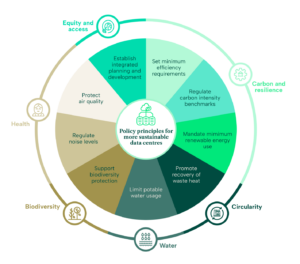
Set against this current landscape, we have identified nine best-practice policy principles to make data centres more sustainable. Follow the link below to find out more.