With the environmental and social impact of data centres requiring urgent action, now is the time for policymakers, regulators and industry leaders to formulate and implement dedicated regulatory frameworks to limit their impact on local communities and surroundings.
Collaboration and transparency are essential at all stages of data centre planning, construction and operation to ensure they operate efficiently, sustainably and contribute to the local community, while limiting their impact on biodiversity and nature.
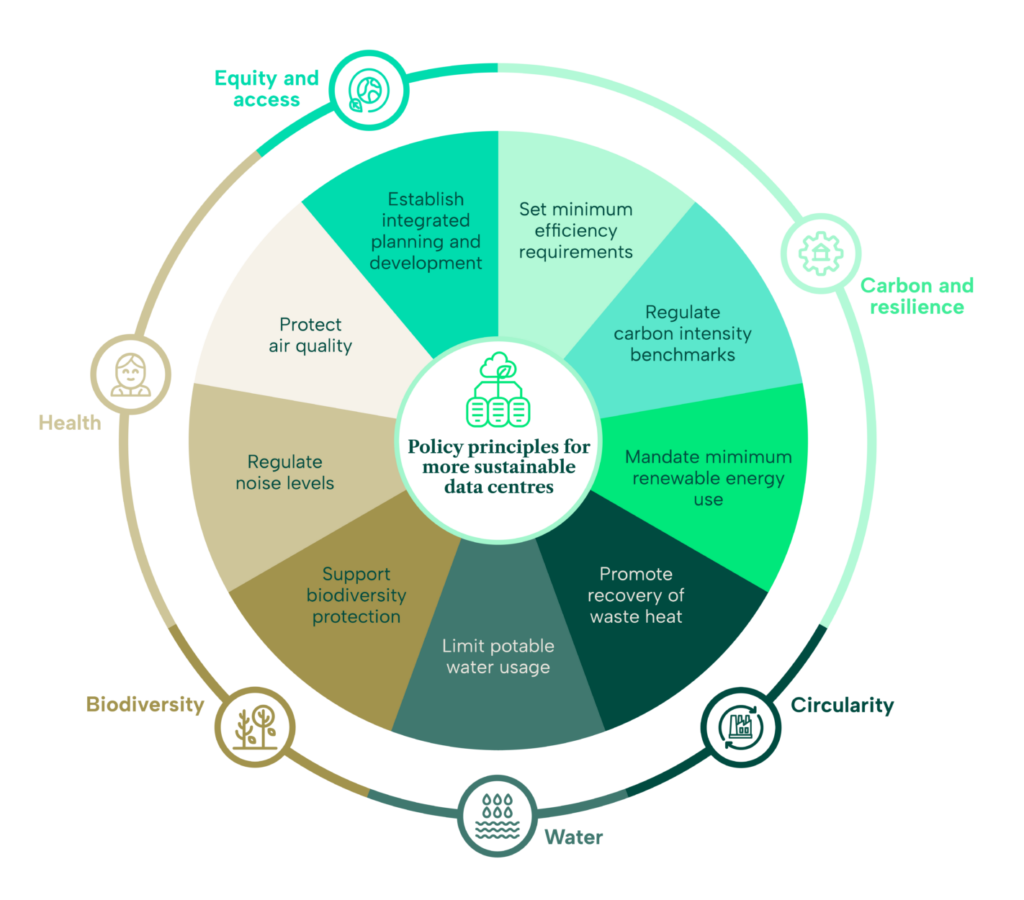
WorldGBC has identified nine best-practice policy approaches to make data centres more sustainable based on a review of existing policies and regulations, interviews with experts, and analysis of resources from our global network of Green Building Councils and corporate partners.
These recommendations for governments and policymakers are mapped against WorldGBC’s Global Policy Principles for a Sustainable Built Environment.
By adopting these guiding principles to improve regulations on data centres, governments, industry and built environment communities can work together to help transform these sites from high-impact energy consumers into resilient, regenerative assets that are aligned with climate targets, support communities and are fit for a sustainable digital future.

Governments can help improve the efficiency and sustainability of data centres by introducing minimum performance standards and requiring public reporting of key sustainability metrics. Relative indicators such as power usage effectiveness (PUE), water usage effectiveness (WUE) and carbon usage effectiveness (CUE) are valuable for benchmarking operational efficiency and driving continuous improvement across the sector.
However, these metrics alone do not capture the full environmental impact of a facility, particularly in siting decisions where total energy demand, water consumption and local resource constraints may be more relevant than efficiency ratios. Greater transparency in both relative efficiency metrics and absolute resource use would enable more informed policy, planning and investment decisions, while supporting the adoption of low-carbon and resource-efficient technologies.

Policymakers can introduce carbon intensity benchmarks (comparing carbon emitted to amount of energy used) that reflect both the facility’s operational energy efficiency and its effective reuse of waste heat. This helps ensure that data centres minimise operational emissions, while also supporting local and national decarbonisation goals.
Governments can reduce the carbon footprint of data centres by requiring operators to source a minimum percentage of their electricity from renewable energy sources, such as solar, wind or other low-carbon generation. Minimum renewable energy requirements can help accelerate the transition away from fossil fuels, reduce greenhouse gas emissions and stimulate investment in clean energy infrastructure.
Where feasible, requirements should increase over time to support national decarbonisation goals while strengthening energy security and improving the resilience of electricity systems. Additional benefits include reducing dependence on fossil fuels and alleviating pressure on national grids through the integration of distributed and locally generated renewable energy.

Legislators can help turn excess heat from data centres into a community asset by encouraging or mandating that waste heat from such facilities is captured and recovered, where economically and technically feasible, to warm local homes and businesses, or power agricultural and industrial processes. Emerging technologies could also soon enable waste heat to be used for water purification and carbon capture.

Governments can improve water stewardship in the data centre sector, particularly in water-stressed regions, by setting limits on potable water consumption and establishing minimum water-efficiency requirements.
Transparent reporting should include both relative metrics, such as Water Usage Effectiveness (WUE), and absolute water consumption figures, as efficiency ratios alone do not fully reflect a facility’s impact on local water resources.
Disclosure of both measures would support more informed policy, planning and siting decisions, while encouraging operators to reduce overall water demand and adopt more sustainable cooling technologies.

Policymakers can help limit the impacts of data centre development on local biodiversity and ecosystems by mandating comprehensive environmental impact assessments and prioritising brownfield development over greenfield sites wherever possible.
Assessments should extend beyond site boundaries and be integrated with wider nature conservation, wildlife protection and land-use planning policies. Such measures would ensure that data centre development supports national environmental goals and local biodiversity strategies while minimising adverse impacts on habitats and ecosystem services.

Noise levels from data centre generators and cooling systems can disrupt the health and wellbeing of employees and local communities. Governments can regulate noise levels by establishing clear noise thresholds and mitigation requirements for data centre operations.

Data centres can help minimise impacts on local air quality by transitioning to renewable electricity, reducing reliance on diesel backup generators, improving energy efficiency and adopting grid-interactive designs. These measures can lower emissions of pollutants such as nitrogen oxides (NOx) and particulate matter.
While data centres rarely improve local air quality directly, brownfield developments that incorporate substantial green and blue infrastructure can deliver additional environmental and air quality benefits, supporting broader climate and public health objectives.

Municipal policymakers can update zoning ordinances to promote integrated planning frameworks to ensure data centres are appropriately sited, coordinated with surrounding land uses, and aligned with infrastructure, energy, water, and community development strategies.
Explore the examples below to see how these principles are already being put into action.
In the US, California Title 24, Part 6 mandates strict energy efficiency rules for data centres, with focus on cooling, air flow, and electrical systems in new builds and major alterations. Key requirements include mandatory airflow management systems for computer rooms, optimised layout specifications that maximise cooling efficiency, and the use of low-energy lighting measures.
Under the Australian government’s Net Zero in Government Operations strategy, all data centres hosting federal workloads must now achieve a minimum 5-star NABERS energy rating. NABERS for Data Centres rates each facility on a 1-6 scale based on its power usage effectiveness (PUE).
Data centres account for about 7% of Singapore’s electricity consumption, which is significantly higher than the global average. The government’s Data Centre Energy Efficiency initiatives aim to reduce the power consumption of IT equipment in such facilities by at least 30% by introducing energy efficiency standards, allowing data centres to operate at higher temperatures to reduce cooling requirements, and implementing a roadmap to improve all data centres’ PUE.
All Germany-based businesses, including data centres, with an average energy consumption above a certain level, must avoid generating waste heat and reuse it where possible. Data centres are also subject to an energy reuse factor (ERF), which means that all operating from 1 July 2026 must achieve an ERF of 10%, with this minimum requirement set to increase over time.
Article 12 of the EU’s Energy Efficiency Directive also mandates public reporting of WUE for data centres with a power demand of or above 500kW. The regulation is part of the EU’s aim to prioritise water conservation as part of its commitment to reach climate neutrality across data centres by 2030.
Parts of Germany’s Energy Efficiency Act require comprehensive, ongoing environmental management systems and reporting that monitor impacts beyond just energy, including environmental protection assessments for new sites.
Authorities in the US city of Phoenix, Arizona, have established specific, actionable plans for data centres to mitigate noise from backup generators and ensure that measures address health and safety issues including power grid reliability, fire risk, emergency response access, and noise impacts.
The City of Phoenix has established a specialised review process for data centres that focuses on site design, water usage, and power grid reliability. Projects now require earlier consultation with city authorities, detailed noise mitigation, and strict adherence to zoning regulations to minimise community impact.
This AI Data Center Energy Performance Framework presents the guiding principles for building and operating energy-efficient AI data centres. With sections covering all stages of planning, design, construction, operation and retrofit, this framework guides AI data centre development toward optimized and energy-efficient performance.
Schneider Electric’s report outlines when to retrofit data centres for AI workloads, the five-step evaluation process required, and how evaluating retrofit feasibility begins with characterising AI workload.
The project in Brescia demonstrates an innovative data centre integrated with a district heating network, using liquid cooling to recover high-temperature waste heat and supply clean energy to buildings. At full capacity, it will generate up to 16 GWh of heat annually; enough for about 1,350 apartments, while avoiding around 3,500 tons of CO₂ emissions per year.
It highlights a scalable model for urban decarbonisation, showing how digital infrastructure can support both high-performance computing and sustainable energy systems by turning waste heat into a valuable local resource.
The data centre integrates at least three independent fiber routes to ensure network diversity, resilience and carrier neutrality, while also embedding sustainability across its supply chain, operations and design, in line with LEED certification standards.