WorldGBC has developed seven sustainable finance taxonomy principles to improve both the usability and impact of taxonomy criteria.

Sustainable finance taxonomies provide a framework for classifying which economic activities are considered environmetally sustainable, based on clear scientific and policy criteria.
Taxonomies align actors globally around consistent sustainability outcomes, helping disparate markets speak the same language on sustainable building investments. They strengthen confidence in sustainable finance metrics, reduce physical transition risks, and foster collaboration across a fragmented landscape.
When taxonomy criteria for construction and real estate are designed effectively, the benefits extend far beyond finance.
Well-designed criteria can enhance operational efficiency, reduce reliance on volatile energy supply chains, and improve indoor air quality. This in turn creates healthier environments and more cost-effective long-term building management.
Together, these benefits help alleviate energy poverty, strengthen energy security, and support the maintenance of asset value.
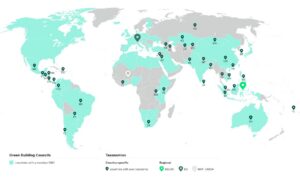
An interactive version of this map is available on page 4 of the publication.
These seven principles have been developed by WorldGBC together with our global network of Green Building Councils (GBCs) and partners.
Each principle addresses a specific gap in how taxonomy criteria are currently designed and applied. Together, they aim to ensure that taxonomies unlock, accelerate and guide capital flows towards the actions most needed in the transition to sustainable construction and real estate.
When developing taxonomies, governments and experts must:

Promote holistic sustainability, considering the full spectrum of environmental, social and economic impacts of buildings across their entire life cycle. Taking action in one area creates co-benefits in others, and taxonomies should emphasise the interdependencies between climate mitigation, resilience, resource efficiency, circularity, biodiversity, health, wellbeing and social equity.

Direct capital to where it is most needed and urgent in the given country, based on an impact assessment, and ensure capital flows beyond just top-performing green assets. Criteria should support reliable data creation and collection.

Ensure criteria are free of jargon and accessible to diverse users, especially financial actors. Criteria should be as simple as possible by providing guidance by actor type, clearly articularing the objective, specifying the performance areas, and providing examples.

Taxonomies should use consistent frameworks, shared language and a unified approach to sustainability benchmarking, allowing for necessary local variations, to help move the sector towards more aligned methods and enable finance to flow more easily to where it is most needed.

Draw on established green finance practices and existing sustainability standards, while referencing locally relevant criteria such as national buildings codes or energy performance standards, to avoid duplication and maximise uptake.

Ensure criteria are practical and technically feasible and that data is available for verification by independent third parties. Evidence requirements should be aligned to the quality and availability of underlying data to build trust, increase market uptake and encourage investment.

Direct capital towards underserved populations and address social considerations, including worker conditions in construction, to provide minimum social safeguards and ensure no activity can be labelled sustainable if it does not meet fundamental social standards.
1. Our global network invites governments to develop, or review and update existing sustainable finance taxonomy criteria for construction and real estate, ensuring alignment with these principles so that taxonomies reflect the realities and opportunities in the construction and real estate sectors.
2. We call for closer collaboration between the finance and building sectors, and the continuous improvement and alignment of taxonomies, green building rating tools and certification schemes.
3. We urge stakeholders to reach out to your local GBC when developing, implementing or updating criteria to leverage the support offered by our local, regional and global network. Visit our global directory of Green Building Councils to find yours.
To learn more about our sustainable finance taxonomy principles in depth, read the full publication.